MedDRA 29.0 introduces complex terminology changes, updates to existing SMQs and operational changes for pharmacovigilance data management. In this article, we review what changes in the new version and which aspects should be considered to keep coding, analysis and the safety database aligned.
At a glance: what’s new in MedDRA 29.0
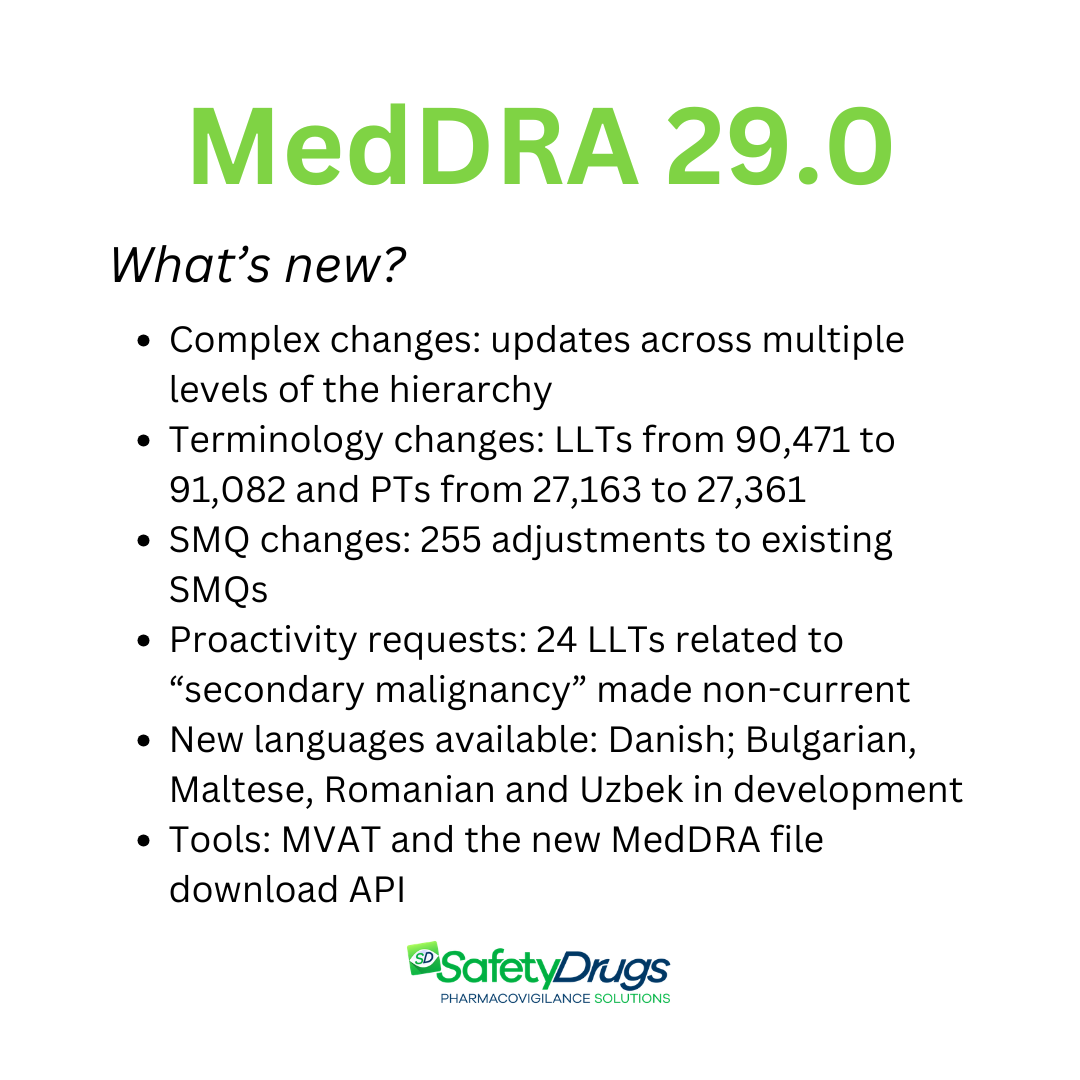
MedDRA 29.0 is a version with complex changes affecting multiple levels of the hierarchy. The main updates include:
- 1,380 change requests considered, of which 1,042 were approved and implemented;
- no new SMQs, but 255 PT changes to existing SMQs;
- an increase in MedDRA terms, with 611 new LLTs and 198 new PTs;
- uneven impact across SOCs, with particularly relevant net changes in Investigations, Injury, poisoning and procedural complications, and Product issues;
- reorganisation of LLTs related to medication errors and therapeutic issues, to distinguish more precisely between “error” and “problem” concepts;
- 24 LLTs related to “secondary malignancy” made non-current, to reduce ambiguity between metastasis and a distinct new primary tumour;
- new MedDRA languages available and under development, with the introduction of Danish, bringing the total to 28 languages, and the ongoing development of Bulgarian, Maltese, Romanian and Uzbek;
- updates to MSSO tools, particularly the APIs for accessing MedDRA files.
Why MedDRA 29.0 requires attention
As a version with complex changes, this update does not only involve the addition or modification of individual terms, but may affect the hierarchical structure of the terminology as a whole.
No changes have been made to existing SOCs or HLGTs in this version. The approved complex changes concern the HLT level, with the introduction of the new term Poliovirus infections and the concurrent retirement of the HLT Poliomyelitis virus infections, now incorporated into the new grouping. This change aligns the terminology with the current taxonomic classification and standard medical usage.
MedDRA 29.0: what changes for coding and data quality
One of the areas with the greatest operational impact in MedDRA 29.0 concerns the reorganisation of terms related to medication errors and therapeutic issues.
The MSSO has reorganised a set of LLTs within the HLGT dedicated to medication errors and other errors or issues related to product use. The objective is to distinguish more precisely between concepts that represent an error and concepts that represent a problem. Terms indicating a “wrong” or “incorrect” outcome without specifying the cause, and therefore without qualifying the nature of the event, have been aligned with “problem” PTs. At the same time, new PTs have been added to clarify “error” concepts.
In terms of clinical precision, MedDRA 29.0 makes 24 LLTs related to “secondary malignancy” non-current in the context of metastasis PTs. This change stems from the recognition that this expression, historically used as a synonym for metastasis, is now increasingly used to indicate a distinct new primary tumour, unrelated to a previous cancer diagnosis.
In the same direction, the LLT Risk of stigmatization has been retired and made non-current to avoid overlap with the new PT Concern about disease-related stigma, which more accurately captures the fear or expectation of social judgement associated with a medical condition. This example shows that MedDRA maintenance is not limited to formal aspects, but also concerns the ability of the terminology to accurately represent relevant clinical, social and behavioural concepts.
MedDRA 29.0 also includes 8 terms with modified names. In all cases, the MedDRA code remains unchanged, while the term name changes. In Italian, for example, Spostamento verso sinistra del setto intraventricolare becomes Spostamento verso sinistra del setto interventricolare. The other changes concern the English names of terms related to parainfluenza virus (Parainfluenzae → Parainfluenza): in the Italian versions, these terms do not change.
SMQs and SOCs in MedDRA 29.0: where to focus controls
MedDRA 29.0 does not introduce new Standardised MedDRA Queries, but includes 255 PT changes to existing SMQs. For teams using SMQs in signal detection, aggregate analyses, internal controls or periodic reviews, this is one of the most critical aspects of the release.
Even when the SMQ name remains unchanged, the revision of included PTs may modify the scope of retrieved cases. Therefore, after loading the new version, it is advisable to verify that SMQ-based analyses are aligned with MedDRA 29.0 and that any comparison with previous outputs explicitly indicates the reference version.
To guide quality controls, it is also useful to consider the distribution of impact by SOC. Net changes are not uniform: the most affected areas are Investigations, with 118 net changes, Injury, poisoning and procedural complications, with 114, and Product issues, with 99. For PV managers, drug safety teams and service providers, this distribution can help define verification priorities, particularly where the database contains a high number of cases coded in these areas or where recurring analyses depend on specific queries on certain SOCs.
For comparison between version 29.0 and previous versions, the operational tool MedDRA Version Analysis Tool (MVAT) is useful.
Languages, APIs and technical updates
MedDRA 29.0 is accompanied by updates in terms of language availability and MSSO tools.
With this version, the number of available MedDRA languages increases to 28, thanks to the introduction of Danish. Translations into Bulgarian, Maltese, Romanian and Uzbek are also under development. For organisations operating across multiple European markets, this progression is relevant to ensure consistency in the communication of coded data.
From a technical perspective, in October 2025 the MSSO made available a new MedDRA file download API, which allows users to obtain files such as LLT, PT and MDHIER in JSON format or in the ASCII format delimited by the $ symbol. Traditional download via ZIP file remains supported in parallel. The Details API has also been enhanced with support for mapping information, and the Type API has been enhanced with stacked display of terms in multiple languages, export of SMQs with their related PTs, and a “search basket” function for exporting terms or hierarchies.
Updating the safety database to MedDRA 29.0
The update to MedDRA 29.0 must be correctly implemented within the safety database in order to keep coding, SMQs, aggregate analyses and regulatory reporting processes aligned. As with previous versions, Max Application installs MedDRA 29.0 on customers’ SafetyDrugs databases and continues to provide the service for loading new versions, allowing users to work with terminology that is up to date and consistent with the official release.
You might be interested in: MedDRA 28.1 what is news for pharmacovigilance